
The Project
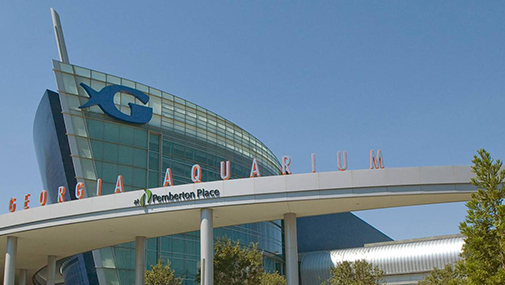
Designed to look like a modern Noah’s Ark, the new Georgia Aquarium, a commercial building in downtown Atlanta (www.georgiaaquarium.org), is destined to be the largest aquarium in the world, with 2.2 million annual visitors as of 2017. The imposing facility includes more than 505,000 square feet (46,916 square metres) of conditioned space housing more than 100,000 animals in eight million gallons (over 30 million litres) of fresh and saltwater.
The Georgia Aquarium's concrete viewing tanks are among the largest in the world—33' (10 metres) tall, with 4' (1.2 metre) thick walls at the base. These walls have many pipe insets, and the tanks themselves contain saltwater.
The concrete supplier, Lafarge North America, therefore had to deal with congested forms that required long-term corrosion resistance. Lafarge developed a close working relationship with a team from GCP Applied Technologies in order to meet these challenges head-on.
In order to deliver high-strength concrete into highly congested forms, Lafarge added GCP's ADVA® superplasticiser to its proprietary self-consolidating concrete mixture, AGILIA®. The self-consolidating concrete moved easily through the congested forms, while the AVDA® superplasticiser delivered strengths above 8000 psi—33% over design specifications.
GCP's DCI®-S corrosion inhibitor was incorporated into the mixture. This admixture resists corrosion from saltwater and extends the lifecycle of concrete exposed to marine environments.
Lastly, STRUX® 90/40 synthetic macro fibre reinforcement was used for secondary reinforcement in slab-on-ground concrete throughout the structure, including concrete walkways, areas near the tanks and other high traffic locations. STRUX® is safer to use, reduces the potential for damage to waterproofing materials placed under the concrete and eliminates the risk of corrosion in this commercial building compared to other types of reinforcement.
Results
The Aquarium opened as scheduled. The contractor noted that the STRUX® fibres ease of handling helped his company maintain their schedule, allowing the Aquarium to open on time.
The use of STRUX® for high-traffic walkways and DCI®-S for the tanks, extended the lifecycle of the concrete in these areas allowing the museum to save on maintenance in the long-term. Similarly, the use of ADVA® superplasticiser ensured that the pipe inset areas of the tanks would remain intact under the highest strains.
John Brett, Commercial Project Manager for Lafarge, says " The mixes have performed very well, and we have been able to adapt quickly
to the fast-changing demands of this project".
gcpat.com.au | Australia customer service: 1800 855 525
GCP Australia Pty. Ltd., 14 Colebard Street West, Archerfield, Brisbane, Queensland 4108, Australia. This document is current only as of its stated date and applies to use in Australia only. Always refer to the latest information available at www.gcpat.com.au. GCP does not accept responsibility for information obtained from other sources. For further information or in the event of any conflict, contact GCP Customer Service.
Last Updated: 2026-04-29
https://gcpat.com.au/en-gb/about/project-profiles/georgia-aquarium-more-just-waterproofing-a-fishtank